Last
Saturday, the Diocesan Youth Movement hosted a training session for
those who work with young people in the Church on Safe Church practices
at St Mary's, Kerrisdale.
The workshop built on our
diocesan sexual misconduct training and allowed us to deepen our
knowledge and understanding of how to create safe spaces for ministry
with children and young people within our ministries. It
was led by Marion Little, Canon Pastor of the Diocese of British
Columbia. The content was put together by the Canadian Red Cross as the
"Prevention in Motion" programme and is used as a training standard by other
organizations that work extensively with children and youth in Canada.
Marion translated this programme into the theology and language of the
Church context in order to make it relevant to our ministry with
children and youth.
Throughout the day, we learned about the
problem of violence against children and youth. We looked at the
definitions and impact of different forms of violence against children
and youth, ways to protect them from violence, how to handle disclosures
of violence and what we can do to help create safe environments for
children and youth. We also looked at factors that can increase the
risks of violence to children and youth. These include children and
youth in institutions, in a disaster setting, using the internet, sexual
minority youth, children and youth with a disability, aboriginal
children and youth, marginalized children and youth, and refugee
children and youth.

As
a Christian community, we are called upon to protect and care for
vulnerable people in our society. This vocation includes the cultivation
of a safe environment in which children and youth can explore their
faith. Since children and youth also participate in the whole church
environment, their safety is a concern and responsibility of the whole
church community. When I first arrived at St Philip's last year, I
worked with Church School coordinator, Erin McDougall and members of
staff to create our own set of Guidelines and Practices for Promoting the Safety of Children and Youth.
The
Church aims to create a place of sanctuary where people are invited to
connect with God, with each other and with the world. If we can create this safe place for children who are
the most vulnerable amongst us, then we can create it for everyone. One
of the most hopeful parts of this training session, in which we dealt
with some very difficult issues was the following statement from the UN
World Report on Violence against Children:
"No violence against children is justifiable, and all violence against children is preventable."
This week in liturgy school, our lesson was entitled Personal Giving.
Together, we answered questions from our text book about the gifts we
have received and how we give to God and the Church. Then each student
was given a sheet with these questions to help them consider their own
giving in preparation for this Sunday.
This coming Sunday is
Stewardship Sunday, when we hope to have collected everyone's annual
pledge cards from the Stewardship campaign. We also hold a lunch after
the service as a celebration of all that we as a Church community have
received from God and rededicated to do God's work in the Church. In
this final week of the Stewardship campaign, I thought I would share a
record of the class' answers to the aforementioned questions from
liturgy school. I hope these thoughts can inspire your own reflections
on how you give.
1. What can people give to God and the church besides money?
- Bread and wine
- space
- land
- loyalty
- food
- skills
- time
- effort
- music
- leadership
- prayer
- communion
- one's soul
2. What are the benefits of giving your time, talent and treasure to God and the church?
- you make God happy
- you feel good
- you do something nice for others
- you are participating in the community
- you are acting out your belief
- you are supporting people who need it
- you support the Church being around in the world
- you can use your gifts in the Church for God
- you build up the community
- you give people opportunities
- you have more opportunities
3.
Money is also an important gift we can give to God and the church. What
reasons do people give for spending money on themselves instead of
giving it to God and the Church?
- It is a waste of money.
- Why should I bother?
- I don't know how to give.
- But I'm poor.
- I need to pay for my house.
- I only get $2/week.
- My parents already give to the Church.
- Other people my age don't give to the Church.
- I deserve this money
The
questions answered here are not the end of this conversation, just as
the stewardship campaign is not the last time we will talk about our use
of resources. There are many important questions that we must continue
to ask ourselves about our responsibilities for how we receive and use
what God has given us. God has provided us with abundant life and many
gifts to enjoy therein. Through good stewardship we celebrate these
gifts and use them to become gracious and generous, like the God in
whose image we are each made.
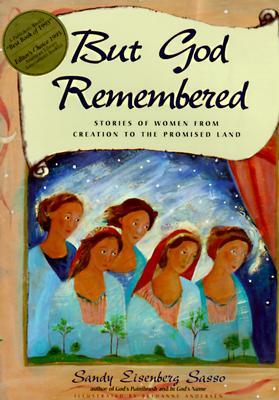
In honour of Remembrance Day, I would like to share a story that comes
from a book in our own library by Sandy Eisenberg Sasso called "But God Remembered: Stories of
Women from Creation to the Promised Land."
 The story is about Memory
and Forgetfulness:
Before God created man and woman, God wanted to create Memory and Forgetfulness. But the angels protested.
The Angel of Song said, "Do not create Forgetfulness. People will forget the songs of their ancestors."
The Angel of Stories said, "If you create Forgetfulness, man and woman will forget many good stories."
The Angel of Names said, "Forget songs? Forget stories? They will not even remember each other's names."
God listened to the complaints of the angels. And God asked the angels what kinds of things they remembered.
At
first, the angels remembered what it was like before the world was
formed. Then as the angels talked about the time before time existed,
they recalled moments when they did not always agree.
One angel yelled at another, "I remember when your fiery sword burned the hem of my robe!"
"And I remember when you knocked me down and tore a hole in my wing," screamed another.
As the angels remembered everything that ever happened, their voices grew louder and louder until the heavens thundered.
God said, "FORGET IT!"
And there was Forgetfulness.
All
at once the angels forgot why they were angry at each other and their
voices became angelic again. And God saw that it was good.
God said, "There are some things people will need to forget."
The angels objected. "People will forget what they should remember."
God said, "I will remember all the important things. I will plant the seeds of remembrance in the soul of My people."
And so it was that over time people forgot many of the songs, stories and names of their ancestors.
But God remembered.
Remembrance is not a one-sided thing, neither is conflict. God created memory and forgetfulness so that we could have peace and wholeness.
We are now well into our annual stewardship campaign at St Philip's and
each Sunday before the service, we have heard from different members of
the congregation about what St Philip's means to them. This week's
stewardship moment, done by Rachel Cassie, was so wonderful I wanted to
share it as widely as possible.
Here are Rachel's words:
Good
morning. My name is Rachel Cassie. As part of stewardship, I was asked
to respond to the question “What does St. Philip’s mean to me?”
I had to think quite a bit to answer this question and I’m still not sure I’m able to put words to it.
Of
course, there are lots of individual experiences that are powerful
memories: many years of the 5:00 Christmas Eve service…Youth group car
washes and sleepovers…Amazing games of hide and seek late at night. I
learned I could actually fit into the lazy susan that was in the corner
of the old kitchen. It made a great hiding place when I was in grade
6.
But that doesn’t really answer the question what St.
Philip’s means to me. I think it’s that St. Philip’s is a place where I
feel kind of rooted. My parents and my grandmother come here. I’ve been coming here to St. Philip’s since I was only two.
St.
Philip’s is about connections, too. You know, through most of my week,
other than my family, I’m almost always in the company of other
teenagers. Church is a place where there are a lot of people…From all
age groups…with whom I have a connection.
St. Philip’s is a quiet, contemplative part of my week. It gives me a space to think – about all kinds of things.
I’ve learned a little about leadership, too through my experience serving.
Oh!
And I have many unusual vocabulary words to pull out in a game of
Scrabble or Boggle. Words like: narthex…or sacristy… or chalice…or
alb.
That’s what St. Philip’s means to me.
Thank
you to Rachel for granting me permission to share your thoughts with the
wider community. I connected very strongly with this as it reflected
what I have experienced as one of the greatest gifts of being part of a
Church community, and that is being able to build caring relationships
with people from many different generations. This was very important to
me when I was growing up and it remains one of my favourite things about
Church life today.
I am very grateful that St Philip's is a community where young people have this experience and are called to share it.